
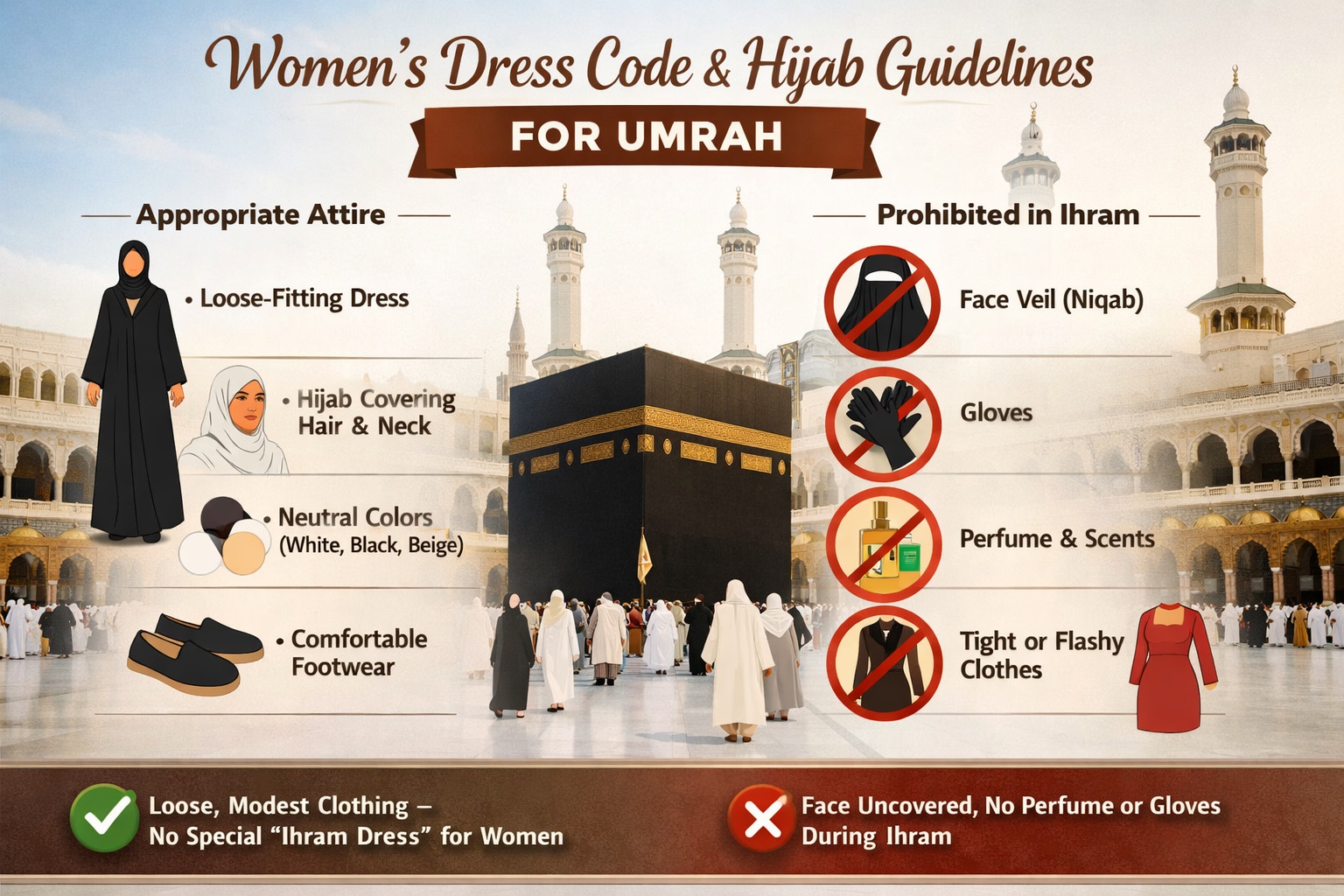
Umrah isn’t about fashion, but it’s also not the crazy mess of wrong information that a lot of people say it is, especially when it comes to the dress code for women and the hijab during Ihram. Mixing cultural habits, travel agency simplifications, and partial religious rulings is what usually causes the confusion.
This guide makes it clear what women can and can’t wear during Umrah, based only on real Islamic rules and information that is consistent across reliable sources.
1. For women, Ihram is not a uniform but a state of mind.
Ihram is a spiritual state for women, not a certain piece of clothing.
Women do not have a set Ihram outfit like men do. Men must wear two unstitched white cloths. A woman enters Ihram by making an intention (niyyah) and saying Talbiyah while wearing any modest Islamic clothing that meets the requirements listed below.
It’s not true that women have to wear white, unstitched, or a certain “Ihram dress.”
2. Basic Rules for Dressing during Umrah
The basics are the same in all five sources:
What Women Need to Wear
- Clothes that cover the whole body except for the face and hands
- Clothes that are loose and opaque and don’t show off your body shape
- Clothes that are simple and don’t draw attention to themselves
- A hijab is a head covering that covers the hair and neck.
Clothes that are okay to wear are:
- Abaya
- Jilbab
- Long dress that isn’t too revealing
- Tunic and loose pants
Women can wear any kind of stitched clothing.
3. the Most Misunderstood Rule: Wearing a Hijab During Ihram
This is where most people get confused.
What Is Not Allowed
A woman can’t wear the following things while in Ihram:
- A niqab (face veil) that has been sewn or shaped to fit the face
- Gloves that go over the hands
This ban is very specific and technical; it only applies to tailored clothes, not modesty itself.
What Is Allowed (and Often Not Followed)
- A woman can loosely cover her face with a hijab or shawl without wearing a stitched niqab.
- It is okay to cover your face with fabric for privacy or modesty, and people have done this in the past.
- Hijab is still required; Ihram does not cancel hijab.
The rule is “no fitted face covering,” not “shows your face at all costs.”
Women who think Ihram requires them to give up modesty in public are not following the rules.
4. Colors, Fabric, and Useful Choices Colors
- There are no rules in Islam about color.
- For modesty, it’s best to wear soft, neutral colors like black, white, beige, and pastels.
- Bright, flashy, and fancy clothes go against the point of Ihram.
Material
- It is very important to use fabrics that breathe, like cotton or linen.
- Heavy or man-made materials make Tawaf and Sa’i uncomfortable.
Comfort is important, not because it’s a luxury, but because being tired makes it hard to worship.
5. Shoes and Accessories Shoes
- Women can wear any comfortable, modest shoes.
- Women don’t have to follow the same rules about Ihram shoes as men do.
Makeup and jewelry
- You can wear very little jewelry, but it’s not a good idea.
- You shouldn’t wear a lot of makeup or nail polish.
- Nail polish makes wudu harder and goes against the simplicity of Ihram.
Scents and Perfumes
- Once Ihram starts, you can’t use any scented products.
- This includes deodorants, soaps, scented lotions, and perfumes.
You can’t change this rule.
6. What Ihram Does Not End
Ihram does not stop:
- Modesty
- Hijab
- Respect
- Common sense
Ihram does stop people from being vain, wearing too much jewelry, and trying to get attention.
The goal is to be humble and focused, not to find technical loopholes or make people uncomfortable.
7. Myths That Are Wrong
- Myth: Women have to wear white for Umrah
Truth: There is no color requirement.
- Myth: Women have to show their whole face
The truth is that only stitched niqab is not allowed; loose covering is fine.
- Myth: Women have a special Ihram dress
Truth: There isn’t.
- Myth: The rules for hijabs are less strict during Umrah.
In reality, the hijab is still required.
Final Thoughts
For women, the clothes for Umrah are simple in principle and strict in purpose:
- Wear Islamic clothes that aren’t too revealing.
- Take care of your hijab.
- Don’t wear gloves or face masks that are sewn together.
- Get rid of smell, extra, and display
- Put comfort first without giving up modesty
You’ve missed the point if your clothes draw attention, make it hard to move, or make things confusing.
Umrah is about giving in, not doing. Wear it like that.
If you go with a good Umrah travel agency in Pakistan like the Shamco Travels Pvt. Ltd then their expert team will guide you about the Umrah dress code clearly and even help in buying the Umrah dress for women.